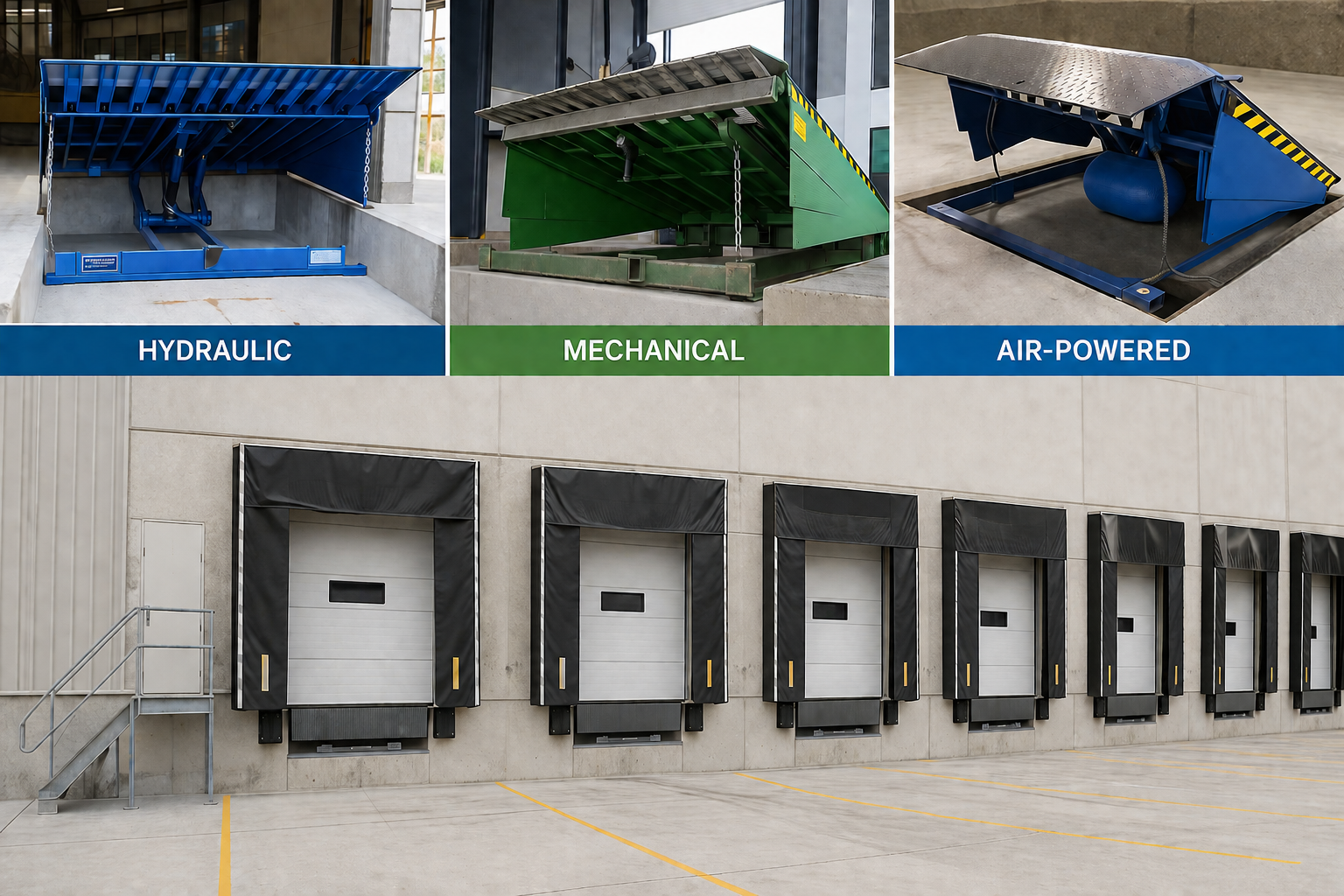
Facility managers can help ensure loading dock safety, productivity, and performance by selecting the proper dock leveler. Depending on whether you manage a warehouse, manufacturing plant, distribution center, or logistics center, your loading docks will constantly be moving freight between trucks and the facility. Choosing the proper dock leveler provides for smooth transitions of both freight and trailers, minimizes downtime, increases productivity, and protects valuable capital equipment. While all dock levelers serve the same basic purpose, they are not created equal. There are three types of dock levelers available — hydraulic, mechanical, and air-powered — each differing in design, function, cost, and maintenance requirements. Prior to purchasing a dock leveler, it is essential to understand these differences to maximize your investment. When evaluating the purchase of a shelter for your loading dock or a dock leveler for your loading dock, it is important to choose one that is applicable to your company's volume of business and frequency of distribution. An effective design of your loading dock systems incorporates both components to provide a safe and energy-efficient working environment. In this guide, we will evaluate the advantages and disadvantages of hydraulic, mechanical, and air-powered dock levelers to help you choose the type that best meets your needs. A dock leveler is used to create a bridge between the loading dock and the truck trailer. Because there are a wide variety of truck bed heights, dock levelers compensate for the height difference between the truck and the loading dock, providing a solid platform for workers, forklifts, and pallet jacks to safely move freight. Without the use of a dock leveler, loading and unloading takes longer, becomes more dangerous, and carries a greater risk of damaging product or equipment. The three primary types include: Each serves the same basic purpose but differs in operation, maintenance, durability, and overall performance. Hydraulic dock levelers are the best and most widely used style of dock leveler in today's modern warehouses and logistics centers. They use hydraulic cylinders powered by an electric motor to raise and lower the dock platform. To operate a hydraulic dock leveler, an operator simply pushes a button on the control panel, and the leveler automatically raises and lowers to the position required. Easy Operation. With just one button, hydraulic systems are easy for workers to operate and require little effort to use, resulting in less exhaustion for those who are frequently loading. Superior Safety. Hydraulic systems provide controlled movement, which can help reduce the possibility of workers being injured due to sudden drops in objects at the worksite. High Durability. Hydraulic components are designed for use in heavy-duty manufacturing environments where equipment is in constant daily use. Low Maintenance. Compared to mechanical systems, hydraulic dock levelers have significantly fewer moving parts subject to high or dynamic loads requiring maintenance. Increased Productivity. Quick operation enables efficient loading and unloading of trucks and increases throughput in warehouses. Hydraulic dock levelers are ideal for: Mechanical dock levelers have been around a long time. They work using springs that lift the platform, released manually to allow for loading and unloading. Instead of an electrically powered device, workers use a release chain to activate this non-powered lifting mechanism. Lower Purchase Cost. Mechanically engineered dock levelers tend to be less costly than hydraulic units and can be a good choice for smaller establishments. No Electricity Required. Since mechanical units use moving parts rather than powered systems, they can still function even during an electrical failure. Simple Construction. With little to no mechanical complexity, these units can suit locations with only temporary loading needs. More Physical Effort. Levelers must be manually activated and operated, placing more strain on the operator's body. Higher Maintenance. As a result of normal wear and tear, spring systems require periodic adjustment, maintenance, and inspection. Reduced Safety. When operated manually, the risk of improper positioning or sudden, unanticipated movement increases. Lower Productivity. Manual handling of the load increases the time required to complete each loading operation. Mechanical dock levelers work well for: A pneumatic dock leveler utilizes an inflatable airbag system rather than hydraulic cylinders or mechanical springs for weight support. An electric fan inflates the airbag, which lifts the platform to the desired height. Once the airbag is fully inflated, the lip of the dock leveler extends outward and the deck lowers onto the truck's bed. Fewer Moving Parts. Fewer mechanical elements lead to lower rates of degradation than spring-loaded systems. Smooth Operation. Controlled travel through the inflatable airbag reduces the potential for sudden shock. Lower Maintenance Than Mechanical Systems. Without springs requiring adjustment, overall maintenance is generally easier. Good Energy Efficiency. Air-operated systems typically require less energy to operate than other options. Air-powered dock levelers are suitable for: Selecting the right dock leveler depends on several operational factors: If your business regularly uses forklifts to load and unload trucks, a hydraulic dock leveler will give you the most efficient and reliable option. Mechanical dock levelers typically have the lowest initial investment, making them well suited to companies with a limited budget or occasional shipping needs. Businesses with a fully dedicated maintenance department can adequately maintain mechanical dock levelers; companies that want minimal maintenance are better served by hydraulic or air-powered units. Businesses focused on workplace safety and ergonomics will generally find hydraulic dock levelers offer the best solution because of their controlled movement and ease of use. Hydraulic dock levelers generally work better in heavy industrial environments such as manufacturing, logistics, and distribution, while smaller warehouses can typically use mechanical or air-powered dock levelers. Having a dock shelter and dock leveler of compatible quality delivers the best performance and safety for your loading area by: Pairing dock levelers with dock shelters is the most economical way to build a complete loading area solution that improves productivity and reduces your company's cost of doing business. Following these guidelines will help extend the life of your dock leveler: Regular maintenance not only minimizes unexpected breakdowns but also extends the life of your dock-leveling equipment. Hydraulic levelers offer the best level of safety due to their smooth, controlled motion and the minimal effort required from the operator. While hydraulic levelers carry a higher initial purchase price, their durable construction, lower maintenance, and increased productivity generally deliver a better return on investment over the long run. If properly maintained, a high-quality dock leveler will typically provide 15–20 years of service, depending on usage and environmental conditions. Yes. The spring-loaded mechanisms and manual components of mechanical levelers usually require more frequent inspections, adjustments, and repairs than hydraulic or pneumatic types. Yes. Dock levelers are available in many types and sizes, all designed to improve the efficiency of loading and unloading at your facility and allow easy transitions between the truck and warehouse floor, regardless of trailer type. Dock levelers are important elements in any warehouse, affecting how well you run operations, how safe your employees are, and how much you pay over time to operate them. If your facility doesn't see heavy load/unload activity, a mechanical dock leveler is a cost-effective way to serve a smaller loading dock. If your facility handles many truckloads per day, a hydraulic dock leveler is likely the better choice, offering convenient operation and higher efficiency than mechanical systems. Air-powered dock levelers offer the most balanced choice between automation and low maintenance at a reasonable price point. When deciding which type of dock leveler to purchase, consider your facility's loading activity, available budget, maintenance capabilities, and relevant safety requirements. Choosing the right dock equipment now can significantly enhance productivity while reducing problems associated with operating a loading dock for years to come. Looking to upgrade your facility's loading dock? Explore Singhania Refrigeration's complete range of dock shelters and dock levelers, or request a quote for your exact facility requirements.Dock Leveler Types: Hydraulic vs Mechanical vs Air-Powered – Which One Is Right for Your Facility?
What Is a Dock Leveler?
Benefits of Installing a Dock Leveler
Types of Dock Levelers
1. Hydraulic Dock Levelers
How Hydraulic Dock Levelers Work
Advantages of Hydraulic Dock Levelers
Disadvantages
Best Applications
2. Mechanical Dock Levelers
How Mechanical Dock Levelers Work
Advantages
Disadvantages
Best Applications
3. Air-Powered Dock Levelers
How Air-Powered Dock Levelers Work
Advantages
Disadvantages
Best Applications
Hydraulic vs Mechanical vs Air-Powered Dock Levelers
Feature
Hydraulic
Mechanical
Air-Powered
Operation Push-button automatic Manual Push-button Initial Cost High Low Medium Maintenance Low High Moderate Safety Excellent Good Very Good Productivity Excellent Moderate Good Physical Effort Minimal High Minimal Best For Heavy-duty operations Low-volume facilities Medium-volume operations Lifespan Long Moderate Long Which Dock Leveler Should You Choose?
Loading Frequency
Budget
Maintenance Capabilities
Worker Safety
Nature of Operations
Why Pair Dock Levelers with Dock Shelters?
Maintenance Tips for Longer Service Life
Frequently Asked Questions (FAQ)
1. Which dock leveler is the safest?
2. Are hydraulic dock levelers worth the investment?
3. How long does a dock leveler last?
4. Do mechanical dock levelers require more maintenance?
5. Can dock levelers be customized?
Final Thoughts